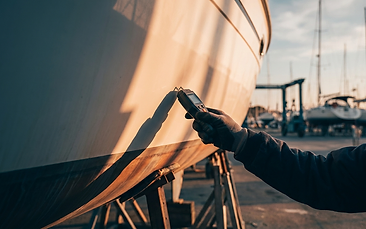

Boat owners often hear the term "wet stringers" during a survey or inspection, but the severity of the issue isn't always clear. Stringers are the backbone of your vessel, and when moisture compromises them, it puts the entire structural integrity of the hull at risk.
What Are Stringers?
Stringers are the longitudinal structural members that run along the bottom of a boat's hull, typically from bow to stern. Think of them as the ribs or chassis of your boat.
Their primary role is to provide stiffness to the hull and distribute the immense loads generated by the engine, waves, and water pressure. Without stringers, a fiberglass hull would flex excessively (oil-canning) and eventually fail.
Most stringers are constructed using a core material (often wood, plywood, or foam) that is encapsulated in layers of fiberglass. This "cored composite" design creates a beam that is incredibly strong and lightweight, as long as it stays dry.
What Are Wet Stringers?
"Wet stringers" refers to a condition where moisture has penetrated the protective fiberglass skin and entered the core material.
Water intrusion typically happens through capillary action. Once water finds a tiny entry point, it migrates through the cellular structure of wood or foam. This moisture becomes trapped; the fiberglass skin that was meant to keep water out now keeps it in, preventing evaporation.
Key Distinction: Wet vs. Rotted
It is crucial to understand that wet does not always mean rotted. Wet stringers have high moisture content, but the core material may still be solid. Rotted stringers have advanced decay where the material has lost structural integrity. However, with the Dryboat process, we can often dry and stabilize even rotted coring, stopping the progression of damage without invasive tear-out.
How Do Stringers Get Wet?
Water is patient. It enters through the path of least resistance, often slowly and invisibly over years. Common causes include:
- Fastener Penetrations: Screws for bilge pumps, battery boxes, or engine mounts that weren't properly bedded with sealant.
- Limber Holes: Drain holes drilled through stringers to allow water to flow to the bilge. If the raw core inside these holes isn't sealed, they act as a straw for moisture.
- Stress Cracks: Aging fiberglass can develop hairline cracks from flexing, allowing water to seep in.
Why Wet Stringers Are a Serious Problem
Ignoring wet stringers is a gamble with your boat's structure and value.
- Loss of Stiffness: Water saturating the core adds weight and can weaken the bond between the core and the fiberglass skin (delamination).
- Rot Propagation: In wood cores, moisture eventually feeds the fungi that cause rot. Once rot starts, the stringer turns to mush and loses all load-bearing capacity.
- Engine Misalignment: Stringers often support the engine mounts. If they soften or crush, the engine can shift, causing vibration and drive train damage.
- Resale Value Killer: A surveyor finding wet stringers is the #1 deal-killer in boat sales. It signals a massive repair bill to any potential buyer.
Wet vs. Rotted Stringers
Wet Stringers
- High moisture readings on meter
- "Tap test" sounds dull but solid
- Core material is wet but intact
Candidate for Drying
Rotted Stringers
- Meter "pegs" at max reading
- "Tap test" sounds hollow or mushy
- Core material is black/soft
Can be Dried & Stabilized
Concerned About Wet Stringers?
Don't wait for "wet" to become "rotted." An early assessment can save your boat's structure without invasive surgery.
The Problem With Traditional Replacement
The "old school" method for fixing wet stringers is drastic. It involves:
- Removing the engines and interior.
- Cutting away the fiberglass floor and tabbing.
- Physically chiseling out the wet wood.
- Glassing in new wood.
This process is destructive, expensive, and time-consuming. It alters the factory structure of the boat and keeps you off the water for months.
A Non-Invasive Approach to Drying
Dryboat International® utilizes a multi-patented, non-invasive process to save wet stringers before they need replacement.
Instead of tearing the boat apart, we drill small, strategic access points (micro-ports). Through these ports, we inject warm, ultra-dry air under pressure. This forces moisture out of the cellular structure of the core, whether it's balsa, plywood, or foam.
This process restores the core to factory dryness standards, preserving the original strength and alignment of the hull stringers. Once dry, the ports are sealed with high-strength epoxy, leaving the structure sound and watertight.
When Wet Stringers Should Be Addressed
Immediate action is the best policy. If a marine surveyor flags high moisture readings in your stringers, or if you notice symptoms like:
- Musty smells in the bilge.
- Weeping rust streaks from engine mount bolts.
- Soft spots in the floor above stringers.
...it is time to act. Addressing moisture early opens the door to preservation rather than reconstruction.
Get a Professional Assessment
We work directly with boat owners, marinas, and surveyors to coordinate non-invasive drying.
Common Questions
- Can you dry foam stringers? Yes.
- Does the boat need to be hauled out? In many cases, yes.
- Is it guaranteed? Yes, survey-guaranteed.